
The term ‘eco-friendly hosting’ gets applied to a range of initiatives: renewable energy data centers, carbon offset programs, and, in InMotion Hosting’s case, refurbished enterprise server hardware.
This article focuses on the practical reality of InMotion Hosting’s Eco-Friendly Servers: what the refurbishment process actually involves, what performance you can expect, and where these servers fit in the hosting infrastructure landscape.
What Eco-Friendly Servers Actually Are
InMotion Hosting’s Eco-Friendly Servers are enterprise-grade server hardware that has been taken out of primary service, securely wiped, fully inspected, updated to current firmware, tested to production standards, and then put back into service. The hardware profile is typically enterprise-class equipment, not consumer or entry-level hardware.
InMotion Hosting formalized the Eco-Friendly Server product line in 2025, shifting the description from ‘refurbished’ to ‘eco-friendly’ to emphasize the environmental value rather than the age of the hardware. The naming change reflects a real shift in how the product is positioned: not as a budget option, but as an infrastructure choice that reduces e-waste and lowers deployment costs while maintaining the same performance, security, and reliability standards as new hardware.
The Refurbishment Process
The distinction between a responsibly refurbished enterprise server and a repurposed consumer machine is significant. InMotion Hosting’s Eco-Friendly Server process covers:
Secure data wiping: All storage media is wiped to DoD standards, eliminating any recoverable data from previous deployments. This is the same process used for decommissioning servers in regulated industries.
Hardware inspection: Components are inspected for physical wear, thermal damage, and performance degradation. Drives, memory modules, and cooling systems that do not meet the established threshold are replaced.
Firmware updates: BIOS, IPMI firmware, and drive firmware are updated to current versions. Outdated firmware is a security risk; updated firmware maintains the server’s security posture at deployment.
Performance testing: Servers are load-tested before being placed into production. This catch-and-replace process means that hardware defects are identified before a customer’s workload encounters them.
Performance Expectations vs. New Hardware
The performance gap between a well-maintained enterprise server from two or three years ago and current-generation hardware depends on the specific workload. For most web hosting use cases, the gap is smaller than marketing for new hardware suggests.
CPU-intensive workloads, particularly those that benefit from newer instruction set extensions or architecture improvements like AMD Zen 4, will see a more meaningful difference. A CPU-bound application doing heavy image processing or data transformation may benefit more from current-generation silicon.
For typical web hosting workloads, the primary performance drivers are RAM capacity, storage I/O, and network bandwidth, not CPU generation. An enterprise server with 64GB of ECC RAM and NVMe storage running from two years ago handles WordPress, WooCommerce, and most SaaS application workloads effectively.
InMotion Hosting’s Eco-Friendly Servers provide dedicated resources, root access, isolation, and control equivalent to new dedicated hardware. They offer the same root access, support for clean OS installs, and custom images as InMotion’s standard dedicated server lineup.
The Environmental Case
Manufacturing a new server requires significant energy and raw materials: rare earth minerals, semiconductor fabrication, and packaging. Extending the productive life of enterprise hardware through responsible refurbishment delays this manufacturing demand and keeps functional equipment out of the waste stream.
Data center hardware generates approximately 49 million metric tons of e-waste annually worldwide according to the UN Global E-waste Monitor. For businesses building or expanding hosting infrastructure, choosing refurbished enterprise hardware over new hardware represents a measurable reduction in environmental impact per server deployed.
This is not a marginal consideration for businesses with ESG commitments or sustainability reporting requirements. Choosing an Eco-Friendly Server is a documented infrastructure decision that reduces your organization’s scope 3 carbon footprint in a verifiable way.
The Seven-Stage Certification That Changes Everything
Performance-first infrastructure starts with validation that goes beyond industry standards. Each reclaimed server completes a systematic certification process designed to identify and eliminate potential failure points before they reach production environments.
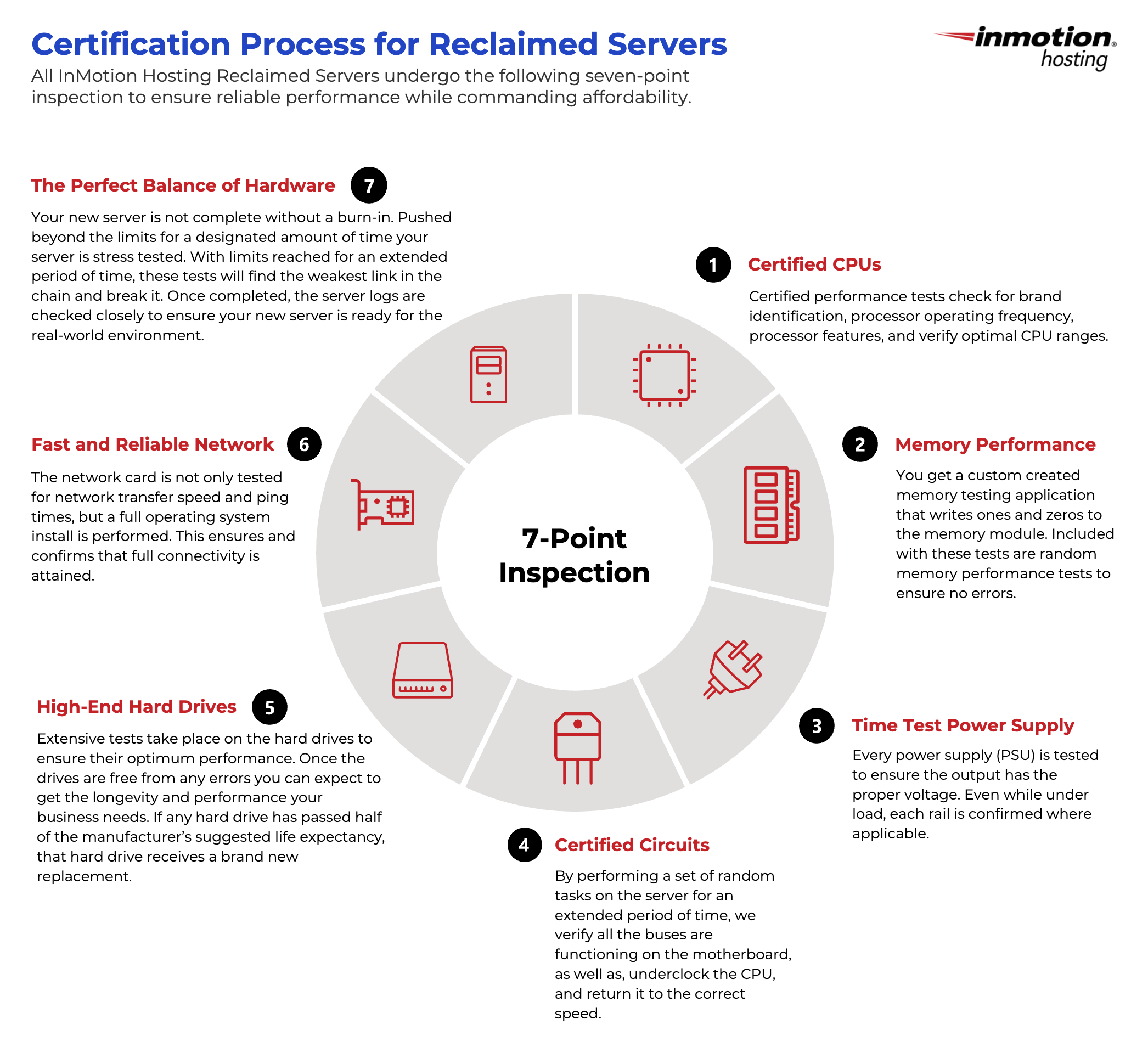
1. Certified CPUs
Certified performance tests check for brand identification, processor operating frequency, processor features, and verify optimal CPU ranges.
2. Memory Performance
You get a custom created memory testing application that writes ones and zeros to the memory module. Included with these tests are random memory performance tests to ensure no errors.
3. Time Test Power Supply
Every power supply (PSU) is tested to ensure the output has the proper voltage. Even while under load, each rail is confirmed where applicable.
4. Certified Circuits
By performing a set of random tasks on the server for an extended period of time, we verify all the buses are functioning on the motherboard, as well as, underclock the CPU, and return it to the correct speed.
5. High-End Hard Drives
Extensive tests take place on the hard drives to ensure their optimum performance. Once the drives are free from any errors you can expect to get the longevity and performance your business needs. If any hard drive has passed half of the manufacturer’s suggested life expectancy, that hard drive receives a brand new replacement.
6. Fast and Reliable Network
The network card is not only tested for network transfer speed and ping times, but a full operating system install is performed. This ensures and confirms that full connectivity is attained.
7. The Perfect Balance of Hardware
Your new server is not complete without a burn-in. Pushed beyond the limits for a designated amount of time your server is stress tested. With limits reached for an extended period of time, these tests will find the weakest link in the chain and break it. Once completed, the server logs are checked closely to ensure your new server is ready for the real-world environment.
This certification process typically takes longer than building new servers, but it produces infrastructure that’s been proven reliable under extreme conditions. You’re not gambling on hardware performance—you’re deploying validated systems that have already passed their stress tests.
Where Eco-Friendly Servers Fit in InMotion’s Lineup
InMotion’s Eco-Friendly Servers sit alongside the standard managed dedicated server lineup, not below it in capability terms. They are available in addition to the Dedicated and High Capacity Managed server lines. The primary distinction is age of hardware, not performance class.
For businesses evaluating dedicated infrastructure who have specific requirements for the latest-generation processors the Extreme plan is the appropriate choice. For businesses prioritizing dedicated infrastructure at favorable economics with a sustainability consideration, Eco-Friendly Servers warrant serious evaluation.
Both lines support InMotion’s full management offering: Launch Assist, 24/7 human support, and Premier Care as an optional add-on. The choice between new and eco-friendly hardware is a workload and values decision, not a support tier decision.
Related: 2025 Year in Review at InMotion Hosting covers the formal launch of Eco-Friendly Server Hosting. How to Choose a Dedicated Server Plan